Charles Demuth’s Bohemian Modernism

Charles Demuth. Nana Visiting Her Friend Satin (detail), 1915. The Barnes Foundation, BF1072
About Research Notes
Did you know that we are always trying to learn more about our art collection? The Barnes has a team of curators, scholars, conservators, and archivists who actively research the treasured works on view in our galleries. We work continually to link collection objects to their original histories, and almost every day we uncover something new—from small details like when a piece entered the collection, to larger discoveries like unknown sketches on the backs of two Cézannes!
We also study our own history as an institution. The Barnes archives, with material dating back to 1902, is a wealth of information about works in the collection—and about the ideas and people that formed it.
Research Notes presents some of our most recent discoveries and interpretations. Read the newest entry below, and keep scrolling for past notes.
Charles Demuth’s Bohemian Modernism
By Robin Morris, graduate intern, collections research
Albert Barnes was a supporter and friend of American artist Charles Demuth (1883–1935) and an avid collector of his work. Their robust correspondence, available at our digital archive, reveals both their shared passion for art and the longstanding affection they had for one another. Today, the Barnes collection contains 44 paintings by Demuth.
Active in the early 20th century, Demuth lived a bohemian lifestyle and is strongly linked to avant-garde circles that shaped the trajectory of modern Western art. Bohemianism, in the modern sense, was popularized in 19th-century France as an alternative way of living. These bohemians valued creative and intellectual endeavors and sought freedom from materialism and traditional societal values. Unconventional family structures, such as community living, supported nomadic and austere lifestyles. The term bohemian originated from the much older term bohème, which was used to describe the Romani people who arrived in French territory in the 15th century by way of Bohemia (western Czech Republic).¹ In the 20th century, Demuth was a modern bohemian par excellence. An intellectual and a gay man living as openly as possible by the standards of the period, he pursued creative projects fueled by the innovative energy of queer art communities on both sides of the Atlantic.
Demuth was passionate about the arts and tried his hand at many expressive practices before directing his attention to painting.² Primarily a watercolorist, Demuth is perhaps best known for his works on paper. Modern in form, with fresh approaches to color and shape, these works also illustrate the modern values that guided his work and the work of his contemporaries. Three watercolors in the Barnes collection in particular can help us trace Demuth’s exploration of modern bohemian subcultures: Jugglers with Indian Clubs (1917), Nana Visiting Her Friend Satin (1915), and Interior with Group of People around Red-Headed Woman (1919).
Demuth’s modern watercolors:

Jugglers with Indian Clubs, 1917. The Barnes Foundation, BF2010

Nana Visiting Her Friend Satin, 1915. The Barnes Foundation, BF1072

Interior with Group of People around Red-Headed Woman, 1919. The Barnes Foundation, BF2007
Interdisciplinary Inspiration
Demuth was born to a wealthy family in Lancaster, Pennsylvania, but did not aspire to join the family tobacco business.³ After receiving a strong formal education in the humanities, he chose to study art at Drexel University, the Pennsylvania Academy of the Fine Arts, and arts academies in Paris.⁴ Through his studies, Demuth joined a network of creatives and gained an appreciation for reading, writing, and performance. He practiced prose, poetry, and acting, but ultimately developed his creative talents in the visual arts.⁵
Demuth’s interdisciplinary interests shaped his artwork—his subjects are often from literature and theater. The artist’s myriad influences are on display in Jugglers with Indian Clubs (fig. 1), found in Room 17 of the Barnes collection. Here, Demuth presents a two-person juggling act. Six Indian clubs (traditional juggling objects) fly across the stage between the performers. The circular shape at center—likely a spotlight—glows yellow and orange, illuminating the action. The stage is decorated with commonplace furniture, such as a table and a floor lamp, and props that include a cane, a black umbrella, and two black top hats.

Fig. 1. Jugglers with Indian Clubs, 1917
The specific combination of props and acrobatics, along with the stage setting, is highly suggestive of vaudeville, a style of performance that originated in France and was popularized in the United States at the turn of the 20th century. A typical vaudeville show featured short, lighthearted acts, including dance, music, slapstick comedy, and acrobatics. Performers were often members of minority communities, such as immigrants and African Americans. Rambunctious and socially clever, vaudeville shows used comedy to critique the elite, which contributed to their broad appeal.⁶ The genre thrived in New York’s Greenwich Village at venues that Demuth frequented.⁷
While Demuth celebrated popular entertainment within Greenwich Village, he also ran in the neighborhood’s bohemian social circles. These groups of educated artists were more interested in breaking conventions than finding commercial success.⁸ One such circle was the Provincetown Players, an experimental theater collective where playwrights, artists, and activists explored intellectual themes. The collective was based at 133 MacDougal Street in Greenwich Village, but had been established in 1915 in Provincetown, Massachusetts.⁹ Demuth, a founding member, was intimately involved during the summers of 1915 and 1916. His experience informed his understanding of stage mechanics, which helped him to accurately represent such spaces within his paintings. However, his intellectual engagement with the Provincetown Players was arguably more influential on his art. The group wrote and performed short plays about modern topics such as psychotherapy and gender relations, themes that appear throughout Demuth’s work.¹⁰
Years earlier, during his first stays in Paris, Demuth gained an appreciation for the evolving overlap between the critical theater associated with the educated elite and other forms of popular entertainment.¹¹ In Paris, circuses, cabarets, and ballets were favorite spaces of creative exchange where avant-garde thinkers pursued new artistic expressions and class intersections. The Ballet Russes, founded in Paris in 1909, exemplified the collaborative nature of the modern art scene. High-profile artists such as Léon Bakst and Pablo Picasso designed sets and costumes for the company, forming a dialogue between the visual arts and the medium of ballet. These collaborations influenced audiences in both directions: elite theatergoers were exposed to avant-garde art, while the innovative approach to ballet attracted new theater audiences. Ultimately, the Ballet Russes blurred the divide between the elite and popular culture, expanding the definitions of ballet and theater.¹² Simultaneously, circuses and cabarets offered similar environments that also dissolved hierarchies. Demuth and other artists who ran in “high-culture” circles sourced subject matter from these venues, elevating popular performance to the status of fine art.¹³
Demuth’s Jugglers with Indian Clubs exhibits his fondness for the stage. The painting’s colorful palette echoes the ballet designs of Bakst, whose work Demuth found exciting.¹⁴ The figures appear to move simultaneously, and their footing recalls ballet—the woman’s toes are pointed, as if just landing an elevé, and the man takes a demi-plié in a wide second position [figs 1a,b]. However, the juggling and stage props clearly reference vaudeville. Demuth’s love of the stage was not bound by culture or class. His unconventional combination of performance styles—American and European, popular and intellectual—is present in his art. This embrace of diverse expressions is characteristic of Demuth’s work where literature, theater, and painting comingle to create an interdisciplinary body of visual art.


Figs. 1a,b. Details of Jugglers with Indian Clubs
Queer Communities
Demuth and his libertine peers rejected repressive heteronormative values that confined sex practices to marriage and determined the nuclear family unit the pinnacle of familial success. Demuth instead prioritized community living, expressed same-sex attraction, and depicted sexual practices that were viewed as uncouth by moral traditionalists.
His painting Nana Visiting Her Friend Satin (fig. 2) embodies a modern view of sex, which Demuth and the bohemians embraced. The scene is drawn from Émile Zola’s novel Nana. Published in 1880, the novel tells the story of Nana, a woman of lower-class status who rises to become a popular courtesan, or upper-class sex worker. While prostitutes and mistresses had served elite figures for centuries, by the mid-1800s clientele had expanded to include the Parisian working man.¹⁵ Courtesans held an elevated status within their field. They were paid in expensive gifts, a practice that reframed their employment as sex workers and gave them a more esteemed reputation than their counterparts of lower socioeconomic status. It is important to note that women pursued sex work out of financial necessity and that the profession, even for those with courtesan status, was stigmatized.¹⁶ While bohemian artists embraced sex-work imagery to express their liberal views, they also employed the subject to titillate viewers—particularly men.

Fig. 2. Nana Visiting Her Friend Satin, 1915
However, Demuth’s paintings featuring sex work pushed beyond the normative gender views that often structured both bohemian and mainstream depictions of women. Nana Visiting Her Friend Satin operates beyond the male gaze and celebrates lesbian love. Nana sits with Satin, her friend, lover, and fellow sex worker. Demuth captures their shared tenderness. Satin rests her head on Nana’s lap in an intimate moment, a contrast to the roles the two women play with their male clients. In 1880, when Nana was published, and in 1918, when Demuth painted this piece, queer relationships were both unconventional and illegal. Those who chose to live as openly gay, as Demuth did within the relative safety of bohemian circles, operated in networks that, by their fringe nature, distanced queer identities from mainstream society. Demuth created 11 pieces inspired by Zola’s novel but took liberties in his rendering of Nana,¹⁷ portraying her as an empowered woman rather than a stigmatized sex worker. Perhaps Demuth’s experience as a queer man made him empathize with Nana and the challenges she faced in society.
Transatlantic Networks
In the early 20th century, bohemian neighborhoods like Montmartre and Montparnasse in Paris and Greenwich Village in New York became inspirational havens for avant-garde artists.¹⁸ These like-minded thinkers formed professional and deeply personal bonds. Members dined together, philosophized, and collaborated on projects, collectively influencing the trajectory of modern art. While Lancaster, Pennsylvania, was the town Demuth called home, his extended time in Paris and New York tied him to the evolving modern art scene.
Demuth’s Interior with Group of People and Red-Headed Woman (fig. 3) conjures the lively meetings of artists and intellectuals working across the Atlantic in the early 20th century. The scene is dark, yet spirited. The room is crowded with people that converse, drink, and smoke. Some individuals gaze pensively into the distance. The scratchy pencil marks convey a sense of energy, as if the room is abuzz with new ideas and creative exchange.
Demuth resided in Paris for about five months between 1907 and 1908 and for a year and a half from 1912 to 1914, networking with a growing constellation of global artists.¹⁹ Through his friend, American artist Marsden Hartley, Demuth made the acquaintance of art collector and writer Gertrude Stein around 1913.²⁰ By this time, Stein had established herself as a central figure in Paris’s artistic and intellectual vanguard. She hosted a weekly event at her home—the Salon de Fleurus—where guests would view her growing modern art collection and discuss new directions in art. It was through these events that Demuth was introduced to the art of Paul Cézanne, Henri Matisse, Pablo Picasso, and Juan Gris, European artists whose work had not yet reached wide popularity in the United States.²¹ It is easy to draw parallels between Interior with Group of People and Red-Headed Woman and photographs of the Salon de Fleurus (fig. 4).²² The salon’s cozy, art-filled space is echoed in Demuth’s composition.

Fig. 3. Interior with Group of People around Red-Headed Woman, 1919

As the Parisian community evolved and welcomed international avant-garde artists—particularly those active in New York—a dialogue formed between the two cities. With his ties to both places and his general social nature, Demuth connected creatives across the Atlantic. For example, Demuth advocated for French-American artist Marcel Duchamp in both New York and Paris. In a 1917 letter, he introduces Duchamp to American art critic Henry McBride, and in a 1921 letter to Gertrude Stein, he writes that he and Duchamp wish to visit her in Paris.²³ The experimental movements that had emerged in Paris at the turn of the century made their way to New York. The modern was not fixed—its style and geographies continued to evolve.
While Interior with Group of People around Red-Headed Woman evokes a Parisian salon, it may actually depict a bohemian gathering in New York. Scholars have drawn connections between Interior and Demuth’s At the Golden Swan, Sometimes Called the Hell Hole, which depicts an Irish saloon in Greenwich Village.²⁴ Both were created in 1919 and both show a large painting hung above chatty guests. Close looking at the painting within Interior reveals the signature “GO. Colman,” referring to Glenn O. Coleman, one of Demuth’s contemporaries [fig 3a].²⁵ Demuth, with his affinity for poetry, was known to play with spelling and word choice—a sign of affection within his personal letters and a conceptual choice within the titles of his artwork.²⁶ Coleman spent most of his career in New York, perhaps another clue that, within Interior, Demuth is depicting an American setting.²⁷

Fig. 3a. Detail of the painting within Interior with Group of People around Red-Headed Woman
Though Paris remained a hub for artistic exploration, by the end of the first World War, New York had emerged as the capital of the modern art scene. In a 1921 letter to his friend, American photographer and art dealer Alfred Stieglitz, Demuth offers a bittersweet reflection on his return home from France. “It was all very wonderful . . . but I must work, here. New York is something which Europe is not. Marcel [Duchamp] and all the others, those who count, say that all the ‘modern’ is to us [New Yorkers], and of course they are right, but it is so hard.”²⁸ Although deeply fond of Paris, Demuth embraced the forward momentum of New York. In the same letter to Stieglitz, he writes, “Together we will add to the American scene, more than has been added since the [1860s] and 70s—maybe more than they added.”²⁹
Past Research Notes
November 2024
“We Should Have a Simple Private Code”: Examining Dr. Barnes’s Telegrams with Paul Guillaume
Assistant archivist Rob Jagiela examines Dr. Barnes’s telegrams with art dealer Paul Guillaume, which employ the now-lost practice of writing in code.

August 2024
Dr. Albert Barnes is known for his world-class art collection. But did you know his wife, Laura Leggett Barnes (1875–1966), had a passion for plants and horticulture that rivaled his love of art? Like Dr. Barnes, Mrs. Barnes pursued her interests intensely and shaped her work and life around them.

June 2024
Combining early European tapestries and modern frames, these chairs have been a longstanding mystery at the Barnes. New research suggests an intriguing background.

March 2024
A close look at a small group of religious objects in Room 16 of the collection.

October 2023
Rancor, Returned Letters & Reconciliation: Dr. Albert C. Barnes and Leo Stein’s Correspondence
The story of Barnes and Stein’s friendship, quarrel, and reconciliation.

August 2023
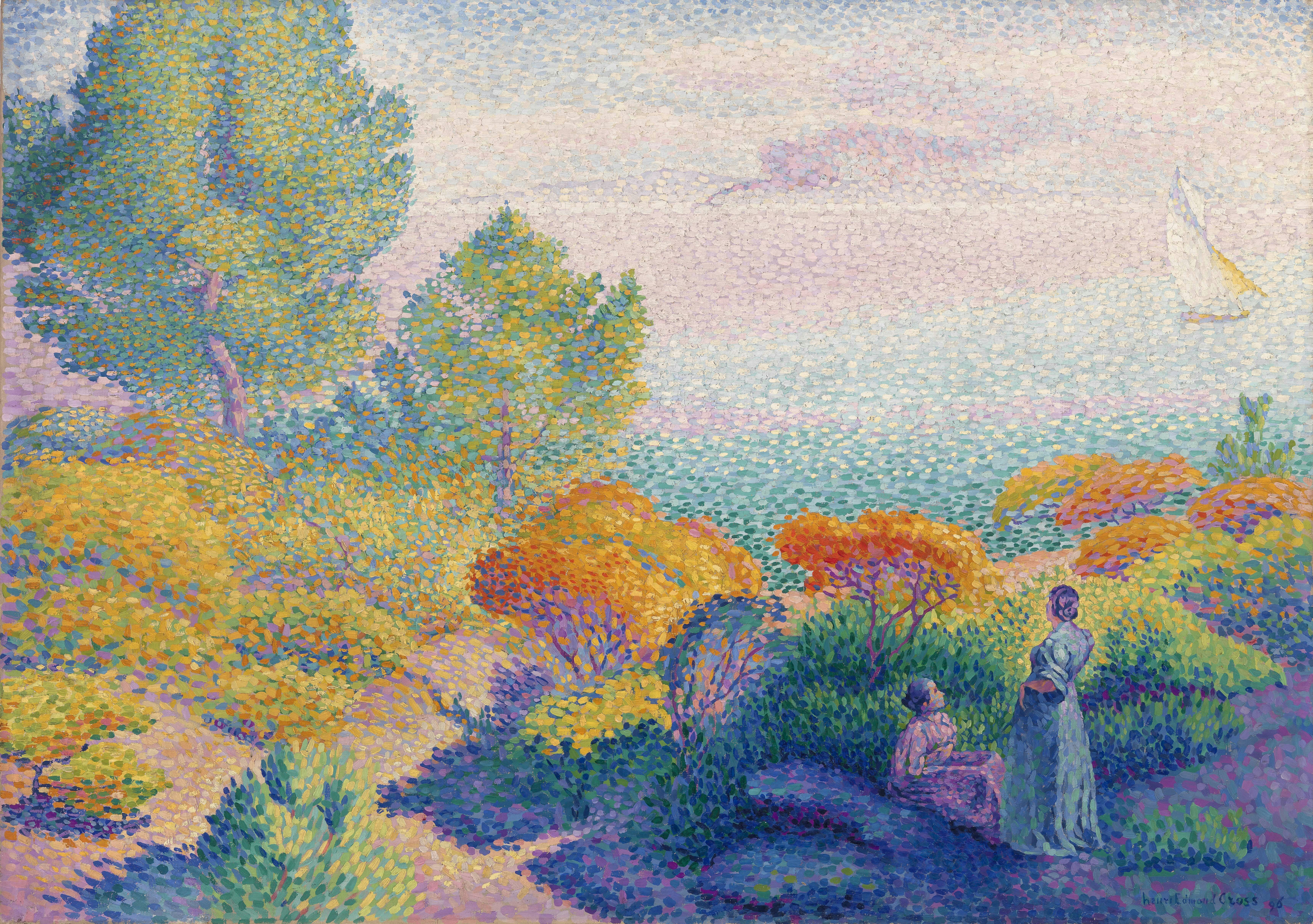
“I Would Like to Paint Happiness”: Henri-Edmond Cross, Two Women by the Shore, Mediterranean
Examine the connection between philosophy, science, and nature in Cross’s work.
June 2023
See how this carved bust was originally part of a much larger ancient Greek funerary marker.

March 2023
Learn how this still life, recently attributed to 18th-century French painter Philippe Parpette, relates to medieval symbolism and the long tradition of botanical illustration.

December 2022
Painted in 1940 at the height of Pippin’s relationship with Albert Barnes, Supper Time marks a transitional moment in the artist's career.

July 2022
Hidden Gems: Tiny Bronze Horses and Bulls from Ancient Greece
Small but mighty, these animal figurines are some of the oldest objects in the Barnes collection. What makes them special, and how did these ancient Greek objects find their way into the Barnes collection?

May 2022
The Life and Death of Tantwenemherti: Reconstructing an Egyptian Priestess’s Coffin
Removing this coffin fragment from its frame led to new discoveries about the object and the woman for whom it was made.

March 2022
A fascinating architectural investigation helps us discover the original location of two pieces of French metalwork.

December 2021
Nearly any collection of Egyptian objects could have a fake ancient artifact hidden in its midst. Forgeries are intended to deceive—to pass as authentic works by specific artists or belonging to specific cultural traditions. Forgeries of Egyptian objects are common, with a long history that continues even today.

July 2021
New research helps identify previously unknown sites in Gritchenko's paintings.

May 2021
From Thebes to Philadelphia: Tracing the Provenance of an Egyptian Relief
See how a chance discovery allowed us to trace a Barnes relief back to its original context in an Egyptian temple and to uncover more details of the object’s history.

December 2020
Alexandros marked a stylistic departure for painter Giorgio de Chirico, who was largely known for his metaphysical works. Is there more beneath the surface of this seemingly straightforward scene?

Giorgio de Chirico. Alexandros, 1935. BF960. © 2021 Artists Rights Society (ARS), New York / SIAE, Rome
September 2020
In the late 19th and early 20th centuries Egyptomania swept the nation—and had a major effect on Dr. Barnes’s collection.

Egyptian. Relief from the Tomb of Khay, 1279–1213 BCE. A107. Public Domain.
May 2020
Thanks to newspaper accounts, materials in our archives, and her own writings, Violette de Mazia’s impact and legacy are clear. But who was Violette before the Barnes?

Unidentified photographer. Violette de Mazia, Angelo Pinto, and others under Seated Riffian (detail). c. 1930s. Violette de Mazia Collection. Barnes Foundation Archives
March 2020
A close look at this enigmatic painting by the prolific Italian artist reveals both a pastiche of childhood memories and his philosophy of metaphysics.

January 2020
Though sometimes overlooked, the glass objects within the Pennsylvania German cupboard in Room 19 are examples of one of America’s earliest craft forms

November 2019
Probably used for beer or cider, the tankard bears the emblem of the bakers’ guild and the inscription: “May God in Heaven bless the field / Bake big bread so that we may make a little money.”

September 2019
If Miró's imagery seems to emerge from the realm of the unconscious, it is at the same time very connected to real-world events.

July 2019
A newspaper critic noted that “whoever enjoys a whimsical imagination will revel in Mr. Demuth’s illustrations of Zola’s Nana... The man who obtains this group of illustrations will be a lucky man.” In March 1922, Dr. Barnes was that lucky man.

May 2019
The sheer number of clocks collected by Dr. Barnes suggests he had an interest beyond timekeeping.

March 2019
The Carnegie Museum wanted to know: Did this painting once belong to the Earl of Northbrook's collection of Italian, Dutch, Flemish, and French old masters?

January 2019
How did art historians piece together the mystery behind this panel? A quasi-forensic search spanning decades was involved.

October 2018
The painting, which depicts a group of horses in a mysterious architectural landscape, is most likely related to images of the Christian apocalypse, which de Chirico may have seen as connected to the rise of fascism after World War I.
